

The Twelve Small Cuts That Kill a Product
You can see a good product in the numbers before you ever hold it.

I’ve read sell-through reports for brands I’d never used and known, by the second reorder, which ones had something real. The repeat rate that holds without a promo behind it. The SKU that doesn’t need a discount to move. The line that comes back season after season while everything around it churns. That pattern is hard to fake, because it’s customers voting with a second purchase, and customers don’t do that for packaging.
There are a few tells, and none of them are about how the product looks.
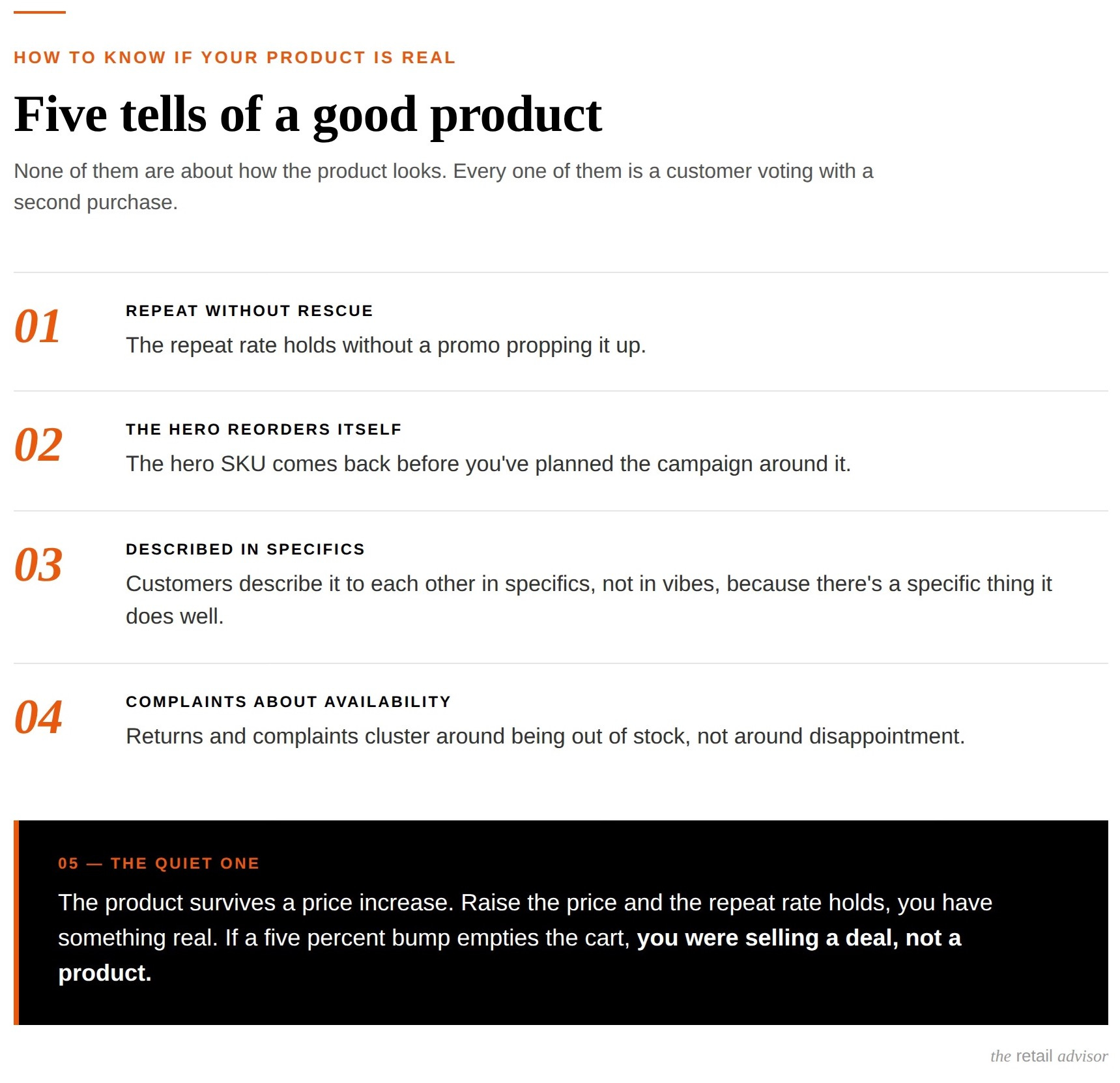
The repeat rate holds without a promo propping it up. The hero SKU reorders on its own, before you’ve planned the campaign around it. Customers describe the product to each other in specifics, not in vibes, because there is a specific thing it does well. Returns cluster around availability, not disappointment. And the quiet one: the product survives a price increase. If you can raise the price and the repeat rate doesn’t break, you have something real. If a five percent increase empties the cart, you were selling a deal, not a product.
Here is what I’ve come to believe after eighteen years of it. Every advantage a brand has is rented except one.
Your acquisition channels get more expensive every year. Your positioning gets copied within a season. Your launch is a single event you have to keep re-staging. All of it erodes the moment a better-funded competitor decides to show up in your category. The only thing they cannot out-spend is a product that is actually better and that people buy again on purpose. That is the whole moat. Everything else is weather.
And almost nobody loses that moat in one decision. They lose it in twelve small ones.
The fill weight drops a few grams. The active ingredient slips below the dose that actually does anything. The fabric moves from the mill that held up to the one that costs eleven cents less. Each cut is defensible on its own and invisible on the P&L for a while. Then the repeat rate softens, and nobody can point to the quarter it happened, because it didn’t happen in a quarter. It happened over a year of small surrenders, every one of them approved by someone who knew better and was tired.
This is the part founders do not want to hear. Protecting the product is not a feeling. It is a job, and it is a hard one, because the pressure is always pointed the other way. Margin pressure says use the cheaper material. Speed pressure says ship it, it’s close enough. Growth pressure says the customer won’t notice. I have sat in a fit session where everyone in the room could see the sample was wrong and the calendar won anyway. Sometimes the customer doesn’t notice. They just don’t come back, and you spend the next year buying their replacements through ads.
Anyone can self-publish now. The barrier to making product has never been lower, and the slush pile has never been bigger. But the bestseller list still runs through an editor. Not because the writer can’t write, but because a second set of eyes that has no ego in the sentence will cut what doesn’t earn its place and protect what does. Every brand I respect has that person somewhere. A founder ruthless enough to kill their own darling. A merchant who will say the fit isn’t there yet. Someone whose only job is to ask whether this is actually good enough to stand the test of time, and who is willing to be unpopular about the answer.
If you don’t have that person, the cuts win. They always win, because they are reasonable and they are quiet.
Make product you would be willing to make again. That is the real test, and it is also the business model. A one-and-done isn’t a product company. It’s an experience company that hasn’t run the numbers yet.


Very good piece beautiful.