

Why your Small Brand shouldn't touch Dynamic Pricing
Big retailers can afford to experiment with dynamic pricing. You can't. Here's what to do instead.

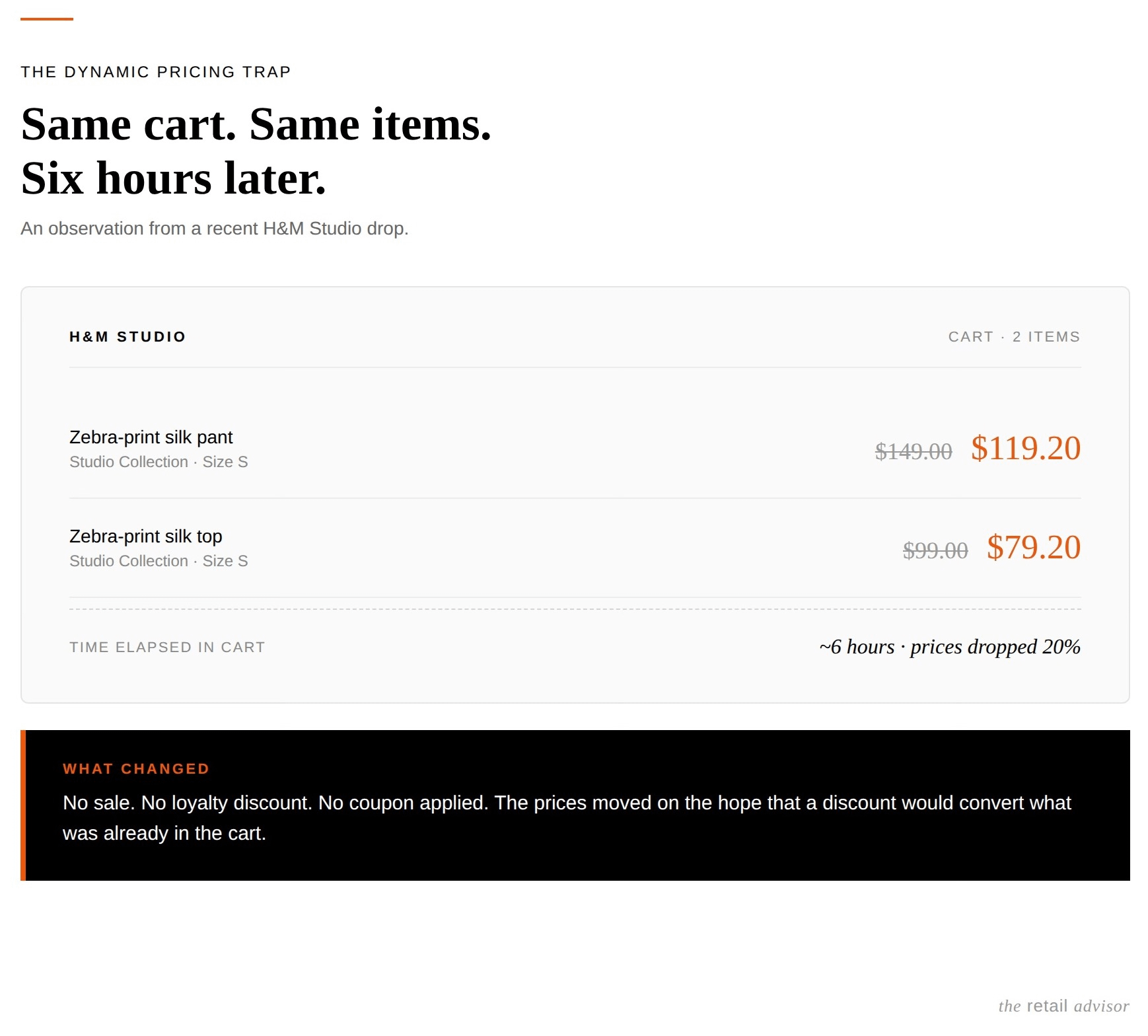
I added a zebra-print silk pant and matching top from H&M Studio’s newest drop to my cart last week. I was at my parents’ place in Palm Desert, no local store at home, so I figured I’d pick it up while I was there. Got distracted by my kids. Came back to my cart about six hours later.
Both prices had dropped 20%.
This was a brand-new collection. Not on sale. I don’t have an H&M loyalty account. The prices had moved purely on the hope that a discount would convert what was already sitting in my cart.
Two weeks later I’m at Target looking for a white tank top. I find one. The hangtag is there, but the perforated section that usually shows the price is blank. I walk to the front of the table and there’s a printed-in-store sign: 2 for $20. I check online: $15. I go back a week later. The table sign now reads $10.
So what does that tank top actually cost? I have no idea. And neither does anyone else in that store.
This is the moment when most founders I work with start asking me whether they should be doing this too.
Don’t.
What H&M can afford that you can’t
H&M moved my cart price down 20% in six hours because the cost of being wrong is rounding error to them. If the discount converts, great. If it doesn’t, the algorithm tries something else tomorrow. They have decades of accumulated margin, a global supply chain absorbing the unit economics, and a brand strong enough that nobody is going to write a Reddit thread about a 20% cart drop.
You don’t have any of that.
When a $5M brand experiments with dynamic pricing, every test runs through working capital you can’t afford to lose. Every markdown that doesn’t convert is a margin point you needed for next quarter’s PO. Every customer who notices her candle dropped $4 in her cart while her friend’s didn’t is a Reddit thread that actually moves the needle on your trust.
The infrastructure to do this at SMB scale is real. The Shopify App Store now has dozens of pricing apps promising the same logic: Prisync, Intelis, Pricing.AI, SpurIT. A 2025 industry survey found 55% of European retailers are actively planning to pilot dynamic pricing with Generative AI in 2026. Bain research finds 85% of retailers report clear benefits from implementing AI-based elasticity modeling. The case studies look great. Prisync + 5
What the case studies don’t tell you is whose balance sheet survived the learning curve.
The trap is the assumption that the problem is your prices
Most of the founders asking me about dynamic pricing have margin problems. They are looking at H&M and Target and reading the trades and concluding that the answer is more sophisticated price experimentation. It is not. The answer is almost always one of three things they already know:
Their bestsellers are priced too low and have been since launch. Their slow-movers are priced where they were when they were new and have not been touched in three seasons. Or their channel mix is wrong and the wholesale margin is dragging down the DTC blend.
None of those problems get solved by an algorithm. They get solved by a founder sitting down with the data and making a decision that should have been made nine months ago.
Dynamic pricing software, deployed on top of those underlying problems, does not fix them. It just runs the same broken pricing structure faster.
The consumer side is moving against this anyway
Recent Morning Consult research found only 29% of U.S. adults are at least “somewhat familiar” with dynamic pricing, and consumer fairness perceptions drop sharply once people realize prices are moving on them. Wendy’s faced backlash after announcing surge tests across drive-through menus and walked it back inside a week. New York’s Algorithmic Pricing Disclosure Act took effect November 10, 2025, requiring retailers to disclose when a price was set by an algorithm using personal data. In 2025 alone, 24 different state legislatures introduced over 50 bills on algorithmic pricing. Morning Consult + 3
The big retailers will weather all of this because they have the legal teams, the lobbying budgets, and the brand equity to absorb the noise. A small brand caught between an FTC inquiry and an angry customer base does not have any of those things.
What to actually do with the energy you were going to spend on this
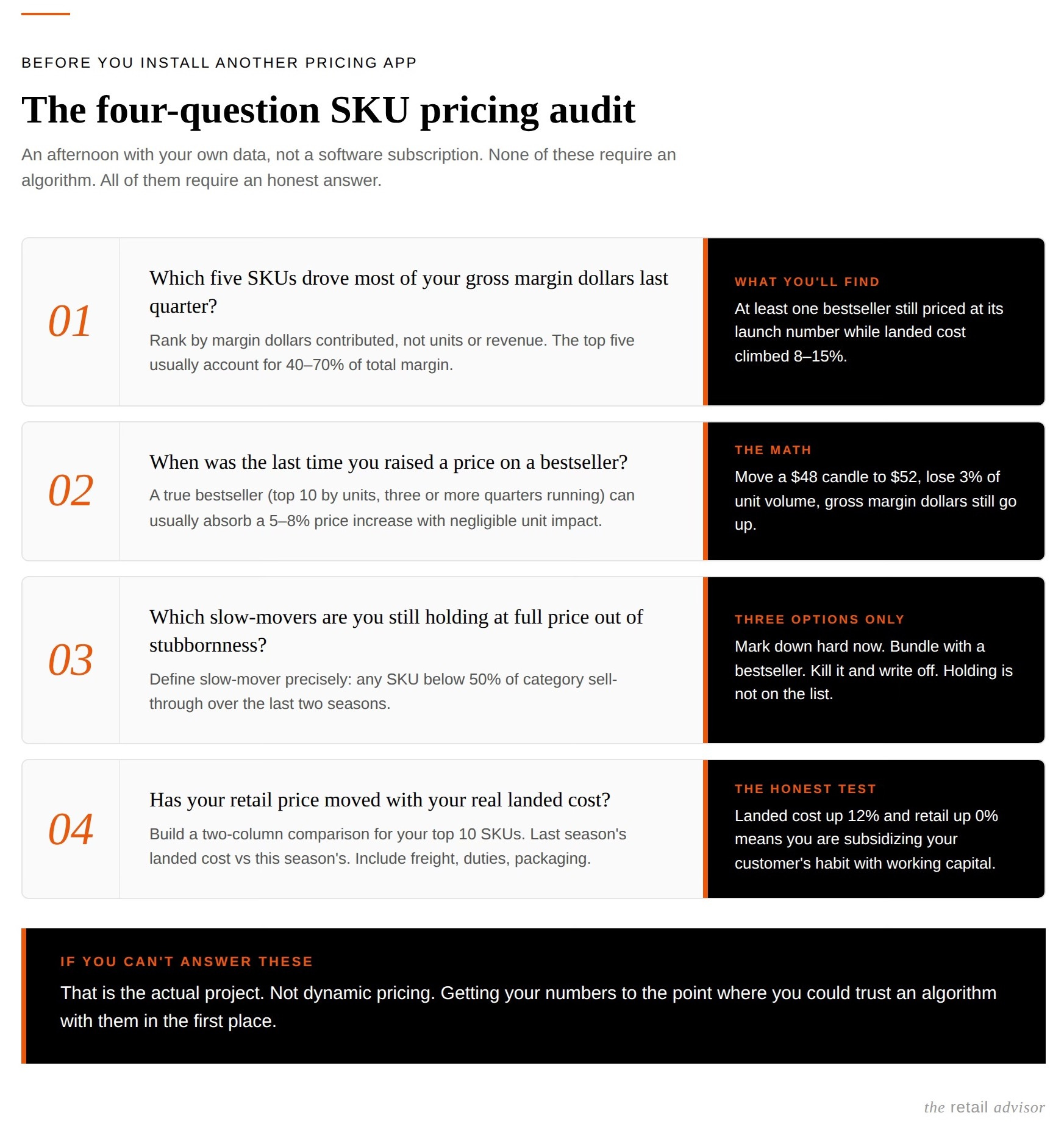
If you were genuinely about to install one of these apps, redirect that hour into the four questions that will actually move your margin. None of them require software. All of them require you to sit down with your own data and answer honestly.
1. Which five SKUs drove most of your gross margin dollars last quarter, and are they priced where they should be?
Pull your last 90 days of sell-through and rank every active SKU by gross margin dollars contributed (not units sold, not revenue, gross margin dollars). The top five usually account for somewhere between 40% and 70% of your total margin. Now look at what those five are priced at. Most founders discover at least one of them has been sitting at its launch price for two years while landed costs have climbed 8 to 15%. That is a price increase you should have taken last spring.
2. When was the last time you raised a price on a bestseller?
If the answer is “I can’t remember,” that is the answer. The general rule for inventory-backed brands: a true bestseller (consistently in your top 10 by units for three or more quarters) can usually absorb a 5 to 8% price increase with negligible unit impact. The math is simple. If a $48 candle moves to $52 and you lose 3% of unit volume, your gross margin dollars still go up. Most founders never run the calculation. They just assume the price is fixed because the customer is used to it.
3. Which slow-movers are you still holding at full price out of stubbornness?
Define slow-mover precisely: any SKU below 50% of your category’s average sell-through rate over the last two seasons. Look at the list. For each one, you have three options and only three: mark it down hard now and recover the cash, bundle it with a bestseller to move it as a unit, or kill it and write off the inventory. What you cannot do is keep it at full price hoping the next season fixes it. The carrying cost of slow-movers compounds. Every month you hold them is a month that cash is not buying inventory that actually turns.
4. What is the real landed cost of your top 10 SKUs this season versus last, and have your prices moved with it?
Build a simple two-column comparison. Last season’s landed cost per unit on the left. This season’s on the right. Include freight, duties, packaging, the things founders forget. Then a third column: what your retail price did over the same period. If landed cost went up 12% and your retail price went up 0%, you are not running a brand. You are subsidizing your customer’s habit with your working capital.
These four exercises take an afternoon. They will tell you more about your real margin position than any pricing app will tell you in six months. And they will tell you whether you have actually earned the right to layer software on top of your pricing structure, or whether the structure itself is the problem.
If you go through these and realize you do not have clean enough data to answer them, that is the actual project. Not dynamic pricing. Getting your numbers to the point where you could trust an algorithm with them in the first place.
This is the kind of work I run with founders inside a 90-day diagnostic. Not because it is complicated, but because most founders cannot find the time to do it without someone holding the calendar. If that sounds like the project you have been avoiding, that is usually the one worth doing first.

